
1In Use
What the Platform Is Used For

2The Job
Anatomy of a Job
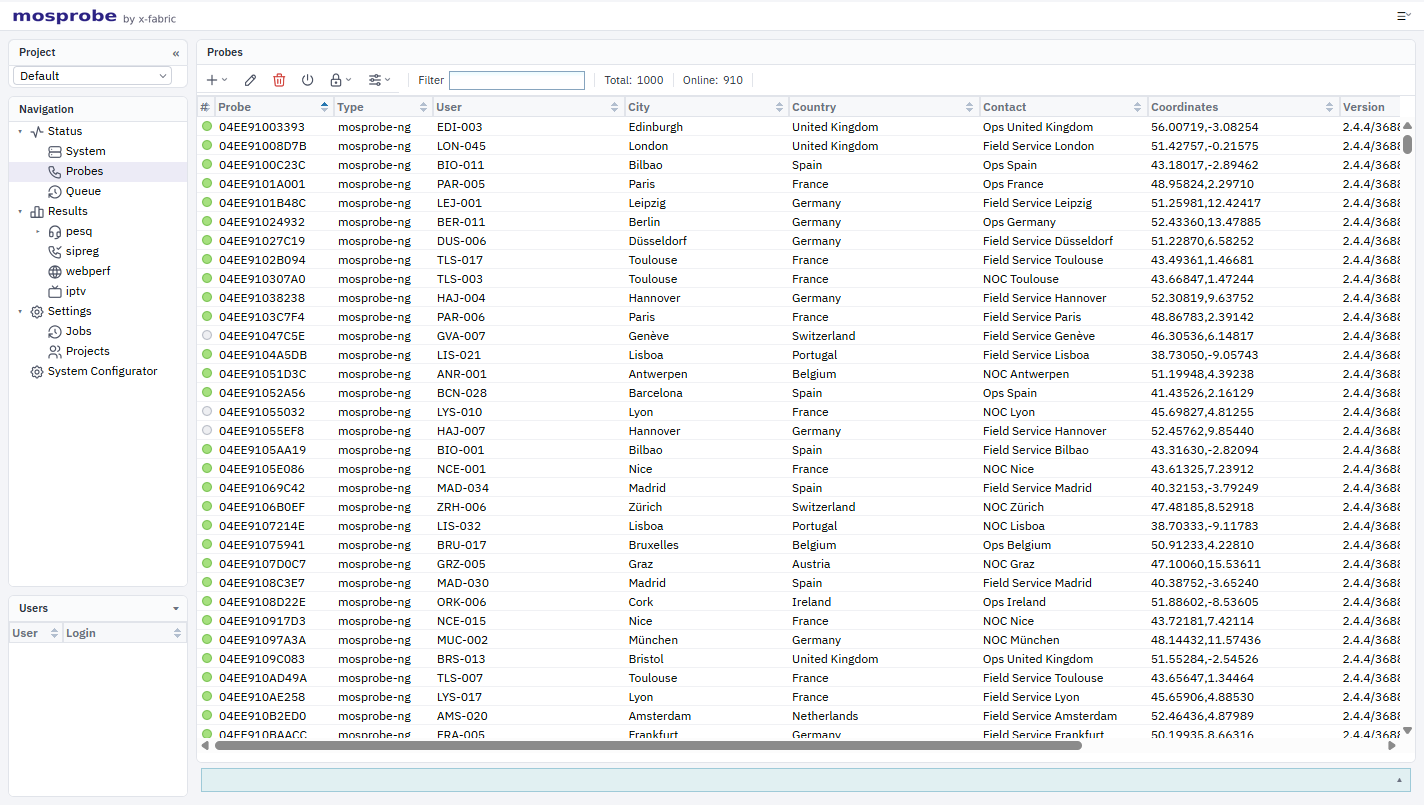
Every job has the same structure. It has a kind of measurement, such as speech quality, web performance or IPTV. It runs in a time window that can be set for each day of the week, and within it at a fixed interval. It uses resources: one or more probes and whatever else the kind of measurement needs, such as an HTTP server for web performance or the channels of the channel line-up for IPTV. Parameters set it up, from the reference signal to the timeouts.
So every new kind of test becomes a new job type and uses the same scheduling, distribution and result handling.
Before a schedule takes effect, the controller plays through the whole day and checks that no line and no resource of a probe is booked twice. This way, voice and data measurements run side by side on the same probe without interfering.
From Schedule to Result
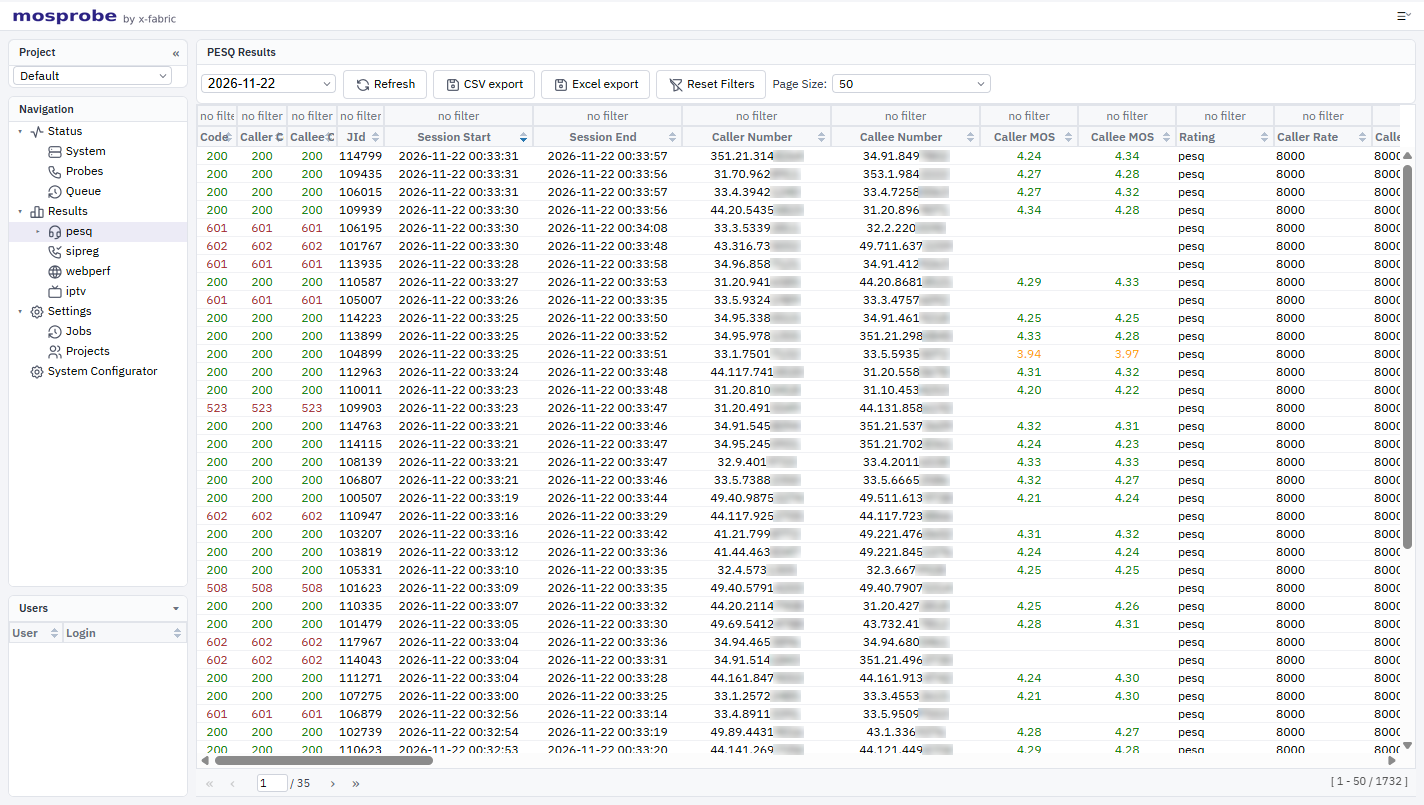
At the scheduled time, the job goes to the probes involved. Every measurement comes back with a result code, success or a cause such as busy or no connection, together with the measured values down to each individual recording. Real-time alarms report faults as soon as they occur. Projects keep measurements and results apart and use users and permissions to control who sees what.
Jobs can also come in as XML from third-party planning tools. Customer-specific reports and SLA evaluations integrate seamlessly through open interfaces.
-
Job 0042Speech Quality with POLQA®
Active- Resources
- Caller over SIP, callee over POTS, each with a phone number
- Parameters
- Reference signal, codec priority for SIP, timeouts
- Schedule
- Monday to Friday, 8 am to 6 pm, every 15 minutes
-
Job 0043IPTV Reception and Zapping Time
Active- Resources
- Probe behind the subscriber's access line
- Parameters
- Every channel of the centrally maintained line-up, one after the other
- Schedule
- Around the clock, including prime time
-
Job 0044Web Performance over HTTP
Active- Resources
- Probe and test server
- Parameters
- IPv4 and IPv6, parallel transfers
- Schedule
- Around the clock, every 30 minutes
3The System
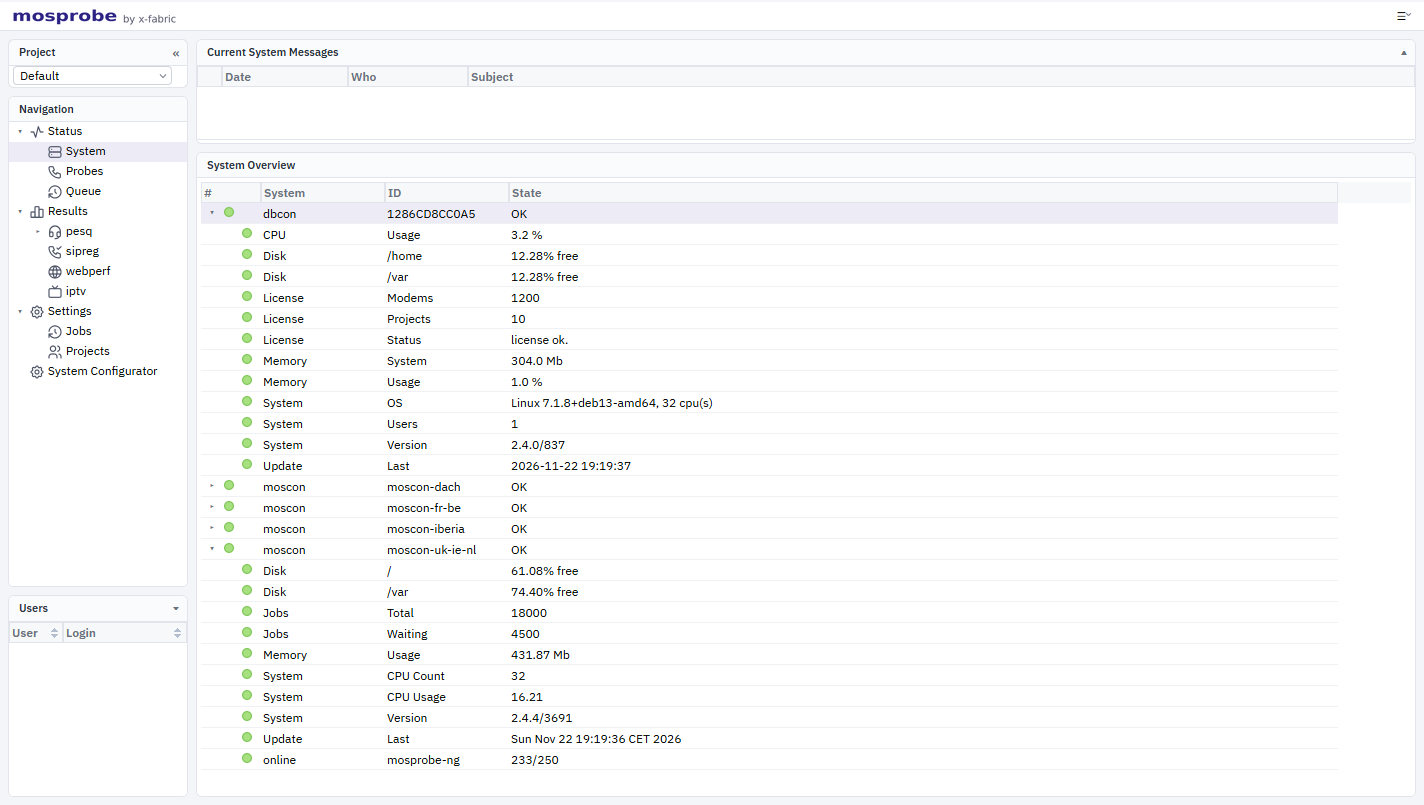
Behind every job are three services. dbcon is the central controller: it schedules the jobs, checks them for conflicts and shows the results in its web interface. The database is built in or runs on your own infrastructure.
moscon passes each job to the probes at the scheduled time and coordinates everything that comes up in real time during the measurement, such as the caller and the callee of a test call.
The post-processors score the raw data centrally. Each kind of measurement has its own; the one for speech quality, for example, computes the MOS for each direction of the call. A new evaluation applies to every probe at once, without any change on the probes.
 Open the screenshot full size
 Open the screenshot full size
 Open the screenshot full size
In-Band or over a Management Network
Control and results travel over the existing infrastructure, as with most customers, or over a dedicated network. Probes for high-bandwidth tests then stay fully isolated from the customer network.
Why mosprobe
- Scales
- Thousands of jobs at once, unattended: automation is distributed, from the lab to the carrier network.
- Open
- Your own alarming and reporting read directly from the database or take the results as CSV or Excel.
- Just Works
- Once set up, the platform runs by itself. Firmware, patches and configuration come centrally; automatic recovery keeps operations running.
- Secure by Design
- Encrypted, authenticated control, user permissions, audit trail. The probe opens the connection to the controller itself: the customer's firewall stays closed.